
Extremadura
Extremadura is one of Spain’s least known regions. It sits in the west of Spain. It borders Portugal in the east, Castile and Leon in the North, Castilla-La Mancha in the east, and Andalucia in the South. The region has a population of just over 1 million people.
It has a rich history with Roman, Moorish, and Napoleonic conflicts all leaving their mark on the region.
You could spend a whole visit just focusing on Roman history and still not scratch the surface of what is on offer.
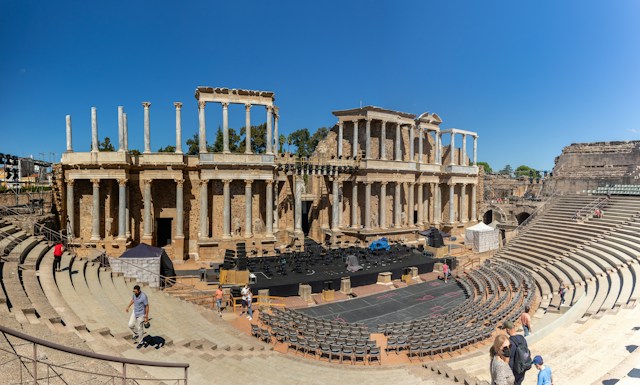
The regional capital, Mérida, was founded as a Roman colony in 25 BC and has many significant Roman buildings on display. The Roman-built Teatro Romano remains in use today. Mérida’s population is only about 60,000 people. The most populous city in Extremadura is Badajoz with 150000 people. Cáceres is the next biggest with 96,000.
There are many things to do throughout the region. As mentioned, Mérida is a great place to see Roman ruins and sites. The National Museum of Roman Art in Mérida is excellent. Cáceres has a well-preserved old town, as does Trujillo. The Archaeological Museum of Badajoz is worth a visit. If you like the great outdoors, then Monfragüe National Park is for you.
For a more detailed look at this amazing region, read Things to do in Extremadura. To help plan your visit to the region, check out our 7 Day Itinerary for Extremadura for helpful tips and suggestions.
Towns and places in the Region
Read information and tips on these regional towns:
Badajoz – offers a mix of medieval architecture, lively plazas, modern shopping streets and strong cultural traditions
Cáceres – is a beautifully preserved medieval city boasting a UNESCO-listed old town, storks nesting on towers, and rich historic charm
Guadalupe – picturesque medieval streets, fascinating museums, traditional Extremaduran cuisine and warm local hospitality
Mérida – is home to remarkably preserved amphitheatres, temples, and bridges, showcasing Spain’s finest ancient Roman heritage and history
Monfragüe National Park – draws nature lovers from across the globe, most hoping to spot a golden eagle or a black vulture riding the wind
Piornal – is Extremadura’s highest village, a scenic mountain retreat in the Jerte Valley, famed for cherry blossoms, hiking trails, and quirky festivals
Plasencia – is a charming walled city blending medieval architecture, a lively market, cathedral heritage, and easy access to the Jerte Valley
San Martín de Trevejo – is a picturesque village with timbered houses, cobbled streets, unique local dialect, and stunning Sierra de Gata mountain scenery
Sierra de Gata – is a beautiful region of small villages in the far northwest of Extremadura, sitting right beside the Portuguese border
Trujillo – is a striking town famed for its grand Plaza Mayor, medieval castle, conquistador heritage, and beautifully preserved Renaissance architecture
Valverde del Fresno – is a traditional Extremadura village near the Portuguese border, known for slate-roofed houses, distinctive local speech, and unspoilt rural charm
Zafra – is a small town that packs in centuries of history. Locals call it “Little Seville,” thanks to its whitewashed streets
Getting to the region
Driving from Madrid to Mérida takes around 3 hours 30 minutes.
You could also approach the region from the south with the drive from Seville to Badajoz taking about 2 hours 30 minutes.
The train trip from Madrid to Mérida will take about 4 hours and 45 minutes. Check Train Schedules & Buy Tickets on Omio.