

Logrono is the historic capital of the La Rioja region. It has a population of around 152,000. It is located in the northwest of the region on the Ebro river.
Logrono has a rich and colourful history. The city has been a Roman and Celtic settlement and has been a part of various historical struggles over the centuries. Fun fact, in 1609 and 1610 Logroño was the main seat of the Basque witch trials, part of the Spanish Inquisition.

The Museo de la Rioja covers the history of the region. As well as important archaeological, artistic and historical artifacts, the museum has a constantly changing range of exhibits.
Concatedral de Santa María de la Redonda is a magnificent twin-towered cathedral in the heart of the city. This baroque building was built in the 15th century and has a beautiful interior that is well worth a look. The Cathedral is in Calle Portales.
When it’s time to eat head Calle del Laurel, the centre of tapas life in Logrono. The street and area can get very busy at night and into the morning but it is a great place to eat from lunchtime onwards.
If you want to visit a typical Spanish market, Mercado de San Blas is a great market located in the heart of the city. You can buy the freshest fruit and veg as well as an endless variety of Jamon, Chorizo and other amazing foods.
Of course, as the capital of this wine region, there are multiple wineries surrounding Logrono that you can visit. All offer tours and the opportunity to sample and buy wine direct from the makers. Some of the better-known wineries include Bodegas Vina Ijalba, Campo Viejo, Franco Espanolas, Viña Real, Olarra and Marques de Vargas however there are dozens more that are worth a visit. If you are interested in wine you could literally spend months visiting wineries in the region.

In the first week of January, the Actual Festival is held. This is an art film and music festival which has been held since 1991. Events include performances by local, national and international artists.
Early May sees the Fiestas of Santo Domingo de la Calzada. This festival celebrates Saint Domingo, his life and the miracles he performed. The festival is also celebrated throughout the La Rioja region.
The Fiesta de San Bernabe celebrates the patron saint of the city. It also celebrates the defeat of the French in 1521. During the invasion, many in the city lived off fish caught from the river. In memory of this, a part of the modern celebrations is handing out and eating fish. The fiesta also includes parades, traditional costumes, food stalls and plenty of local wine. There are a host of events for all ages. The festival is celebrated on 11th June each year.
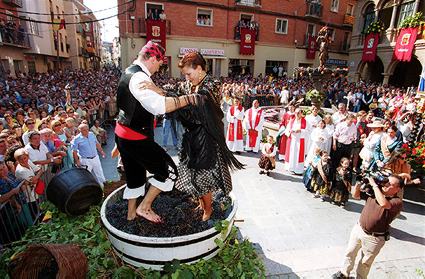
The biggest event of the year is the Fiesta de San Mateo or Grape Harvest Festival. It happens in the week of 21st of September each year. As you´d imagine there are plenty of grape and wine-related events throughout the week. These include traditional grape crushing by foot and the consumption of plenty of wine. Other events include parades, sporting events, concerts, markets and fireworks. If you like your wine and a good time, then you should check it out.
“My number one tip for Logrono is take your time and enjoy.”
Logrono is about a 3 hour 40 minute drive from Madrid. It is a 1 hour 30 minute drive from Bilbao and around 2 hours drive from San Sebastian.
We drove from Vitoria-Gasteiz which is about a 1 hour drive.
By train it is about 3 hours 10 minutes from Madrid.
If you are doing the Camino de Santiago, you will reach Logrono on day seven to nine depending on your pace.